
Killjoy Manifesto

In this text, Ahmed discusses happiness often, which makes sense, as a killjoy entails killing joy, or happiness. In her words, “Happiness is used to justify social norms as social goods.”

As we live in an unjust world, being happy in it would signify complicity in these wrongdoings. In being visibly unhappy, we can denounce these norms and show disagreement. In the ten principles, she outlines what it means to do this.

Principles 1-3 exhibit how happiness should not define a killjoy’s life, by not making it their cause, being open to unhappiness, and identifying with those who do the same. Not everything is worth creating conflict, however. A killjoy can measure the worth of doing so by determining how unhappy they are with what is causing unhappiness.

Principles 4-6 outline how it is important to be defensive in situations of unfairness. Lesser violent forms of oppression are still inherently furthering that oppression, whether that be seemingly harmless humor that feeds off of injustice, histories that are being silenced or rewritten, or even the mere inclusion in an oppressive system. As it is commonly known, “if you are neutral in situations of injustice, you have chosen the side of the oppressor.” In this way, being happy manifests neutrality and therefore acceptance of an oppressive system.

Principles 7-9 act more as stipulations for a lifestyle as a killjoy, by redefining what it means to be happy for oneself, regardless of the standard social scripts or personal bonds that may interfere.

Principle 10 is ensuring resilience from members of the killjoy movement. To be part of it is to be strong and to fight whatever measure of oppression is being disguised as happiness.

I thought that this chapter was empowering! Feminists are so often painted as miserable creatures, who are overly intense and scream about their vaginas constantly. While this still may be true, it was pleasant to see this rage painted as passion in a more positive light.

It was interesting to see happiness defined as a socially constructed norm that we are pressured to confine to, rather than a defined script. I feel like there are so many goals and aspirations that we are expected to achieve and complete, like a checklist, but the reality is that we have the ability to define our own versions of it as we see fit, even if killing happiness brings us happiness.
The Uses of Anger: Women Responding to Racism by Audre Lorde

A large focus of this piece is aimed at black woman to confirm their right to anger from a lifetime of oppression coming at them not only from the institutionalized racism and sexism, but also from white women who they are supposed to be working in conjunction with. Lorde’s voice is directed individually to Black women, white women, and other women of color, while also speaking to women as a whole. Lorde is confirming Black women’s right to anger, while guiding them to not let it tear them apart. She wants Black women to harness their anger to fuel their fight for personal success and change. White women come into play because she is pointing out to them how their guilt and fear of Black women’s anger only continues the oppression of all women. Micro aggressions by white women towards Black women when they are all working towards change and equality not only adds to the burden of anger Black women are saddled with, but also stifles real change in how women in general are thought of and treated. White women’s historic exclusion of race, sex, age, religion, sexuality, or class as all conjoining forces of oppression makes real systemic and societal change impossible. I believe Lorde is trying to validate Black women while also helping them not let the anger they carry keep them from using it to propel them, not hold them back. I also think Lorde’s other main message is that women do not have to have experienced every type of suffering and oppression to support and lift each other because this will simultaneously lift all women’s shackles. A quote that I think really exemplifies Lorde’s over all message is, “Any discussion among women about racism must include the recognition and the use of anger”(128). Racism creates anger from the suffering it causes and to ignore it is choosing to still turn a blind eye to main faucets of racism. How can women talk about racism if they are not willing to talk about all the components that it is made up of and the consequences it causes? 

Overall I loved this piece. I think especially as a white woman I need to read these types of texts to better understand how my privilege can be used and the ways in which I need to recognize it. I also think when working with others to end suffering it’s crucial to try and get an understanding of the pain and anger that both creates and compounds suffering.

There was one quote that I both loved and was confused by: “Everything can be used/ except what is wasteful/ (you will need to remember this when you are accused of destruction” (127). In context of the piece I believed this meant that anger and suffering fall under the “everything can be used” umbrella unless they result in negative reactions, like feelings of guilt or self-destruction, because those fall under being “wasteful”. I thought the last sentence was especially important because all women who demand and work for change will be accused of destruction and the first two lines will help women be able to see more clearly who is actually to blame for the destruction and suffering from the status quo. Did others read it this way or am I just not understanding it correctly?

Gould, “The Emotion Work of Movements”

Deborah Gould’s piece, “The Emotion Work of Movements”, looks at the ways in which the AIDS activism of ACT UP challenged notions of how displays of emotion should and can be used to accomplish the goals of a movement. Gould draws attention to how ACT UP redirected feelings of shame about homosexuality to government shame over its handling of the AIDS crisis. Or, as Gould writes, how “…ACT UP harnessed grief to anger and both feelings to confrontational action.” (223).

Divisions within AIDS activism and competing ways of utilizing emotion within the movement to ensure impact and sustainability are detailed by Gould as it relates to organizing and taking a more militant stance. One example of this that stood out to me is when Gould mentions the mixed emotions of AIDS activists towards the memorial quilt, a display of activism which is compared to the holding of political funerals for those who died of AIDS. While many activists note that being able to grieve is necessary, the quilt represents a sort of sanitized version of the reality of those who were affected during the crisis.The quilt thus can be said to represent a form of “acceptable” grieving, as the reality of death is stripped away and there is no disruption in the form of protests and political funeral processions. Gould then references the call for spreading the ashes of those who had died on the lawn of the White House — an act which directly contrasts the example of the quilt in terms of its unwillingness to ignore the reality of the situation and to separate anger from grief.

Moreover, Gould explores how ACT UP essentially “authorized” fury suppressed by shame in a way that “…harnessed and subordinated grief to anger…” so that “grief could hardly be felt as something other than anger.” (235).

Learning from the 60s-Audrey Lorde

This piece makes the point that “there is no such thing as a single-issue struggle because we do not live single-issue lives.” Lorde finds this to be a central issue when looking back on what happened in the 60s. She describes feelings of animosity within the black rights movement that went horizontal–all different black groups were so focused on an oppression olympics that made it even more difficult to organize and stand together against racism. Who is poorer and who is blacker took a lot of energy away from making productive change. There is no one solution to racism, this is true, but instead of turning on each other that anger should be used to turn against the oppressors. This piece is trying to intervene in the fighting amongst people of color that distracts from fighting racism. Efforts to reclaim the future cannot be private or individual–everyone has to work together to make change. “Hopefully, we can learn from the 60s that we cannot afford to do our enemies’ work by destroying each other.”

Something that excited me was when Lorde said it is important “Not to believe that revolution is a one-time event, or something that happens around us rather than inside of us,” (141). The idea that revolution is something that happens inside of us is so powerful. It is up to us to decide change needs to be made. It is internal when we communicate the need for change with each other and it is something we have to decide we are fully committed to doing. It happens on an individual level with people deciding they will no longer stand for injustice and then within groups as the ideas spread and people come together to fight oppression. Revolution being inside of us is an exciting idea. You can’t just wait to watch it happen around you, or it will never happen.

I think in class a good thing to talk about may be discussing how we can each personally learn from history and build the tools to recognize issues of infighting and how to deal with them. Maybe discuss how to better listen and constructively deal with our own feelings in a way that would be productive to change instead of just theoretically. Do we in our own lives participate in behaviors that put down other oppressed groups? How do we acknowledge and fix this? What can we do to help?

Opening Reflection

I am an introvert who is also quiet. So, just a fair warning, my participation and presentation skills are awful. Don’t get me wrong, I am a great active listener; however, when it comes to talking in class, I either talk a little or not at all. There are also times when I get overwhelmed in my head when I get called on like I start to think about hundreds of things at once and I freak out. The worse is when I actually start to present or facilitate a discussion, you can tell by my body language and the tone of my voice that I am internally distressed. It is something that I have always wanted to improve; but, it still has not changed. I actually took this Feminist Reconceptualization class last semester with nine other women, and I barely contributed with the class. So I don’t know if I can even bring any participation in this seminar. Hopefully, you all can just bear with me.

Browsing through the title of the readings and theme for the week, I am interested to see what fictional speculation is and how it will intertwine with feminism and with the rest of the themes. I also merely enjoy narratives that surrounds itself with imaginations.

Opening Reflection

My identity and community is made up of being a huge advocate for equity, combating hate, and supporting the LGBT community. Both of my brothers are in the LGBT community and that has brought this community very close to my heart since I was in middle school when they both came out.

I am bringing a lot of excitement for all that I have yet to learn. I have loved every Women’s studies course I have ever taken and I hope to leave this one with new perspectives and knowledge to help me be even more compassionate towards others and increase my ability to combat hate and suffering in this life. My only fear going into this class would be that I am an emotional and passionate person and I get embarrassed sometimes by my inability to control these emotions in front of classmates!

Feminist conflict to me is all the differing opinions, backgrounds, and history that feminists bring into an arena and how these will always clash. I see these internal battles as feminists facing against one another when trying to make change. Some major historical conflicts have been with white feminists exclusion of black and gay women. This is an example of a conflict due to exclusivity, which isn’t what feminism is about. Though feminist conflicts are necessary to both improve feminism and what it can accomplish, as well as standing for inclusivity and standing against those who wish to cause harm.

I am really excited to discuss the unit on “Feminist Approaches to Conflict, Abuse, and Harm”. This not only sounds interesting, but I also think it will have a practical use for me since I hope to work in organizations that try to deal with daily conflict, abuse, and harmful situations.

The only thing I am a bit nervous about is the “Challenges to Trans Exclusion” part, since one of my brothers is trans I know some of these readings are going to make me so angry and upset that it will be hard to see other sides/opinions.

Opening Reflection

I come from a conservative upbringing, so I’m no stranger to conflict. Debating (mostly arguing) with my family has become such a regular occurrence that I almost enjoy it now. It has given me the opportunity to construct and defend my beliefs from a unique standpoint.

I’m excited to learn more about feminist conflict because it’s an issue that seems like should have a simple resolution, yet it is so complex that it sends my thoughts into a spiral. Like it says in the course description, “Why can’t we all get along?” As a collective group of feminists, it would make sense that we could, as the ultimate goal is empowerment for women. However, as this goal doesn’t start and end in the same place for all, it isn’t entirely as simple as getting along.

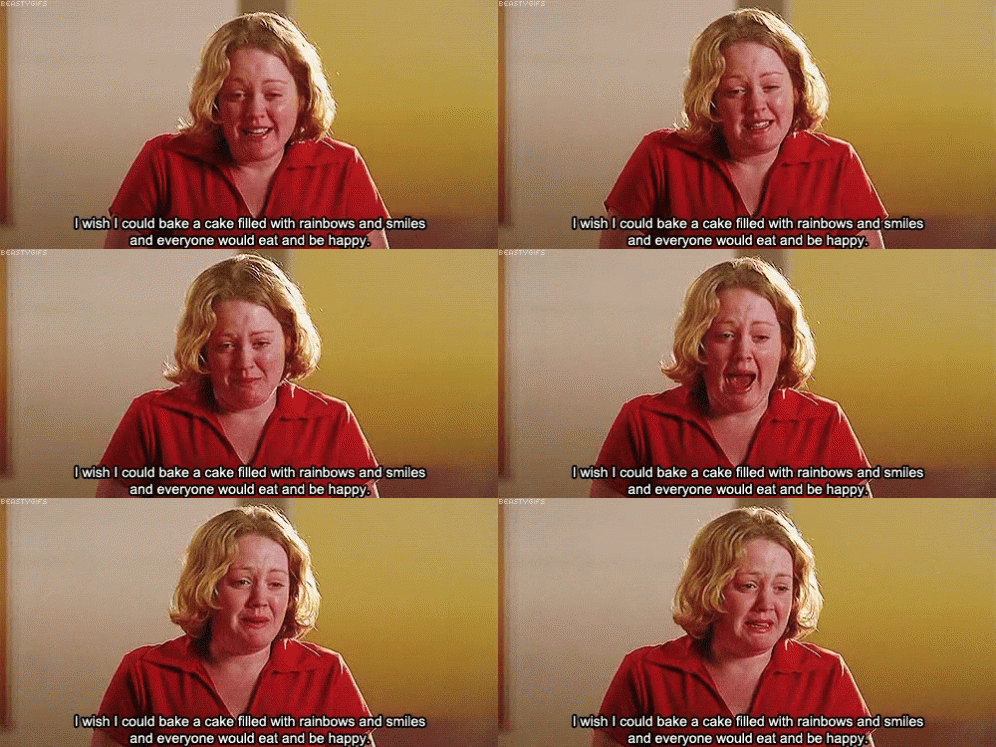
Image result for mean girls bake a cake

I feel like there is often debate about those who proclaim to be feminists, yet are criticized for not being the “right” feminist. Is there such thing? Is anything better than nothing, or is it useless unless one is doing everything they can, even though trickle down doesn’t work? I think it’ll be interesting to dive deeper into this and maybe come closer to attaining an opinion on some of these thoughts.

I’m particularly excited for the Sex Wars discussion. Last Spring, I studied Prostitution and the Sex Trade in Copenhagen, Denmark. I have learned about and been to countries in Europe that regard sex work as violence against women and some that deem it as empowering, but I know little about it from a historical perspective in the United States. I am also just generally interested in sexual behavior and the norms that surround different versions of expression.

I love Women’s Studies for the small classes and how important the small discussions that occur in class are to our learning. We can learn so much from each other, especially in the event of disagreement, and I’m excited to learn from all of you!

Opening Reflection – Katie Dallimore

My name is Katie and I am a current senior at UMD. I am majoring in Government & Politics and Women’s Studies and minoring in International Development and Conflict Management. My career goals are to work in the field of international development, specifically working on projects and programs created to help empower women in developing nations. I was born in Wales and immigrated to the United States when I was six years old. My entire extended family still lives in the UK, so I feel like this experience has given me a small taste of what the immigrant experience for many female immigrants. My background allowed me to be a part of the Global Communities Living Learning program at UMD where I was able to meet many people from all over the world and learn more about their culture. I am very grateful for this experience, and fully believe that the sharing of our cultures can bring people together.

I am looking forward to this class. The class is small and a group of individuals who are dedicated to learning about feminist theories and how they conflict with each other. Feminist conflict, to me, describes the instances in feminist history where theories or ideas conflicted with each other, causing a divide between a movement. This is not to say conflict is a bad thing, because it happens in every single study and social movement. I am excited to learn more about these conflicts, specifically trans-exclusionary radical “feminists” and the sex wars. I believe that trans-exclusionary radical “feminists” will be a topic that frustrates many of us, but important to acknowledge that there are people who call themselves feminists while promoting a transphonbic agenda. I am looking forward to discussing the sex wars because pornography is still a topic that is debated in the gender studies world. It is interesting to see how women have accepted sex positivity and “reclaimed” pornography by removing the male gaze. I don’t think there will be many topics in this class that people will disagree strongly on.

Opening Reflection

Beginning this semester, I am excited for all of the discussions we will be having. Feminist conflict, and areas of difference and disagreement, have always been something that has been touched on in the women’s studies classes I have taken, but I’ve never gotten the chance to consider it so closely in a discussion/classroom setting. I am expecting that having a small group setting will encourage dynamic conversation. As someone who doesn’t always feel comfortable speaking in a larger classroom setting, I think that having a much more close-knit group will help me to feel more at ease participating and sharing my thoughts and opinions. Additionally, being in a class which is specifically focused on exploring conflict, or varying tensions and disagreements that arise in feminist groups and discourses, I hope will push me out of my comfort zone when it comes to discussing different topics and perspectives. Even though I try my best to be as open to different perspectives and opinions from my own, most of the people I have these conversations with in daily life tend to share similar beliefs and opinions to mine, with little to no variance.

Looking through the schedule, one of the topics I am most excited to get to discuss is the sex wars, as this is something I have previously learned of in other classes but don’t know much about. I also am looking forward to discussing how fictional speculation fits into everything we will be looking into this semester; I am always interested in the ways that fiction and world building intersect with and offer commentary on contemporary issues and social norms.

Julie’s Opening Reflection

Hello all, my name is Julianne McHugh but you can call me Julie. I am a senior Public Relations major and I am also pursuing a certificate in Women’s Studies. I decided to pursue a certificate in Women’s Studies after taking WMST250 my freshman year. I absolutely loved the course and how different it was in comparison to the rest of my classes. I have taken many WMST and LGBT courses since and have learned so much from each.

            I am a cisgender female and a very feminine one at that. I love to shop and play with makeup, although you probably won’t see me dressing up for class any time soon. I am also in a sorority at UMD and I always love bringing the information that I learn in my WMST classes back to my sisters so that we can grow together and be a chapter of strong, independent, “woke” women.

            This semester I hope to learn how to better deal with conflict within the world of feminism and be able to open my eyes to both sides of an issue to better understand how to confront it. I’m also hoping to learn a lot from the other students in my class, whether that is from the stories they bring to discussion or just their own opinions on certain issues. One of my favorite things about WMST courses is that they are mostly discussion based and a lot of what you learn from them comes from the opinions that every individual brings to the conversation. I hope to bring my own predispositions to class and maybe open the minds of the other individuals in my class as well.

            Feminist conflict is a hard topic to discuss because it sometimes goes against what it means to be a feminist. In the world of feminism, as I understand, it is in your principles to be open-minded to many issues but also fight for what is right for both women and humanity. The trouble with that though, is that not everyone has the same opinion or beliefs, and not every feminist defines feminism in this same way. This is where we see feminist conflict arise. For me, and I’m sure for many of you, I would love to see a world where everyone gets along and world peace has been achieved, unfortunately that is just not attainable at the moment. So, in order to tackle the issue of feminist conflict we must discuss it.

            I am excited to learn more about feminist conflict and how we will define it in this class, as well as the different ways that we can go about dealing with it. I am nervous for the times where we may find conflict within our class due to varying opinions, but I am hopeful that we will talk through it and have a better understanding of each other. I believe that this class will be tremendously helpful for the world that I am about to enter after I graduate in May and I cannot wait to dive in and learn all that I can from this course.