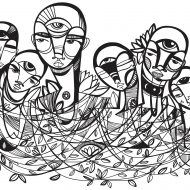
Theory in the Flesh
The second section consists of poems and short essays about marginalized people, especially women of color, experiences of their oppression and pain. “A theory in the flesh means one where the physical realities of our lives — our skin color, the land or concrete we grew up on, our sexual longings — all fuse to create a politic born out of necessity.” The authors use their own experiences and the understanding of the “flesh” of their people from the forced encampment of Indigenous people, Japanese-Americans, and mothers as laborers to demand a collective understanding of solidarity within their communities.
It is no surprise that “Invisibility is an Unnatural Disaster: Reflections of an Asian American Woman” by Mitsuye Yamada is the most compelling and relatable essay for me. Yamada reflects the double invisibility among Asian Americans, and how we have been oppressed and stereotyped as a “silent” struggle. Yamada urges us to speak out and defy the cultural codes of being silent. Through my experiences, I never said much about the racism and the bullying towards me. Like Yamada, “I would ‘let it go’ because it was pointless to argue with people who didn’t even know their remark was racist. I had supposed that I was practicing passive resistance while being stereotyped, but it was so passive no one noticed I was resisting; it was so much my expected role that it ultimately rendered me invisible.” From lack of practice, my voice is weak; however, I try to raise my voice a bit more each day, especially when it makes people say, “this is so uncharacteristic for you.”

Yamada’s essay was one of my favorites from this section, as both she and you point to here — the experiences and anger of Asian Americans, and women in particular, often is ignored. And, when it becomes unable to be ignored, it then gets written off as a sort of “defect”. I like the point you bring up about passive resistance and also of speaking up and defying “cultural codes of being silent”– while I can’t connect in exactly the same way, this is something that also resonated with me from the reading.